Krishnanunni C G

I am a postdoctoral researcher at the Institute for Mathematics, Heidelberg University, where I am working with Prof Jakob Zech. I obtained my PhD in Aerospace Engineering from UT Austin in 2026 under the supervision of Prof. Tan Bui-Thanh, with a doctoral committee that included Prof. Thomas J. R. Hughes, Prof. Clint Dawson, and Prof. Qiang Liu. I was a member of the PHO-ICES group, Oden Institute for Computational Engineering and Sciences from 2021 to 2026. Previously, I received a bachelor’s degree in Civil Engineering from National Institute of Technology, Calicut in 2017 and a master’s degree in Structural Engineering from Indian Institute of Technology, Madras in 2020.
I come from a mechanics background where I undertook projects on signal processing, optimization, and mathematical modelling in solid mechanics with Prof. B. N. Rao at IIT Madras and Prof. Mohammed Ameen at NIT Calicut. I was fortunate to be awarded a research fellowship to work with Prof. Phoolan Prasad at the Indian Institute of Science, Bangalore who exposed me to rigorous mathematics behind nonlinear hyperbolic waves and in particular allowed me to appreciate the beauty of mathematics in mechanics. Currently, my broad interest lies in anything creative and mathematically beautiful.
Research Focus of my PhD Thesis
Most neural architecture search methods treat network structure as a discrete hyperparameter to tune by trial and error. My PhD thesis takes a different path. I ask whether there exist continuous mathematical objects which can be used to inform where, and how to grow a neural network, and derive such objects rigorously. The central contribution is to define a network topological derivative for neural networks, borrowing ideas from topology optimization in mechanics. We ask key questions such as: in what sense does adding a layer constitute a perturbation of a neural network graph, and answer them in a mathematically principled way. Other contributions in the thesis involve the design of the LiLaN architecture for simulating stiff ODE dynamics and proving a universal approximation theorem for LiLaN.
Full details and the thesis are available (Here).
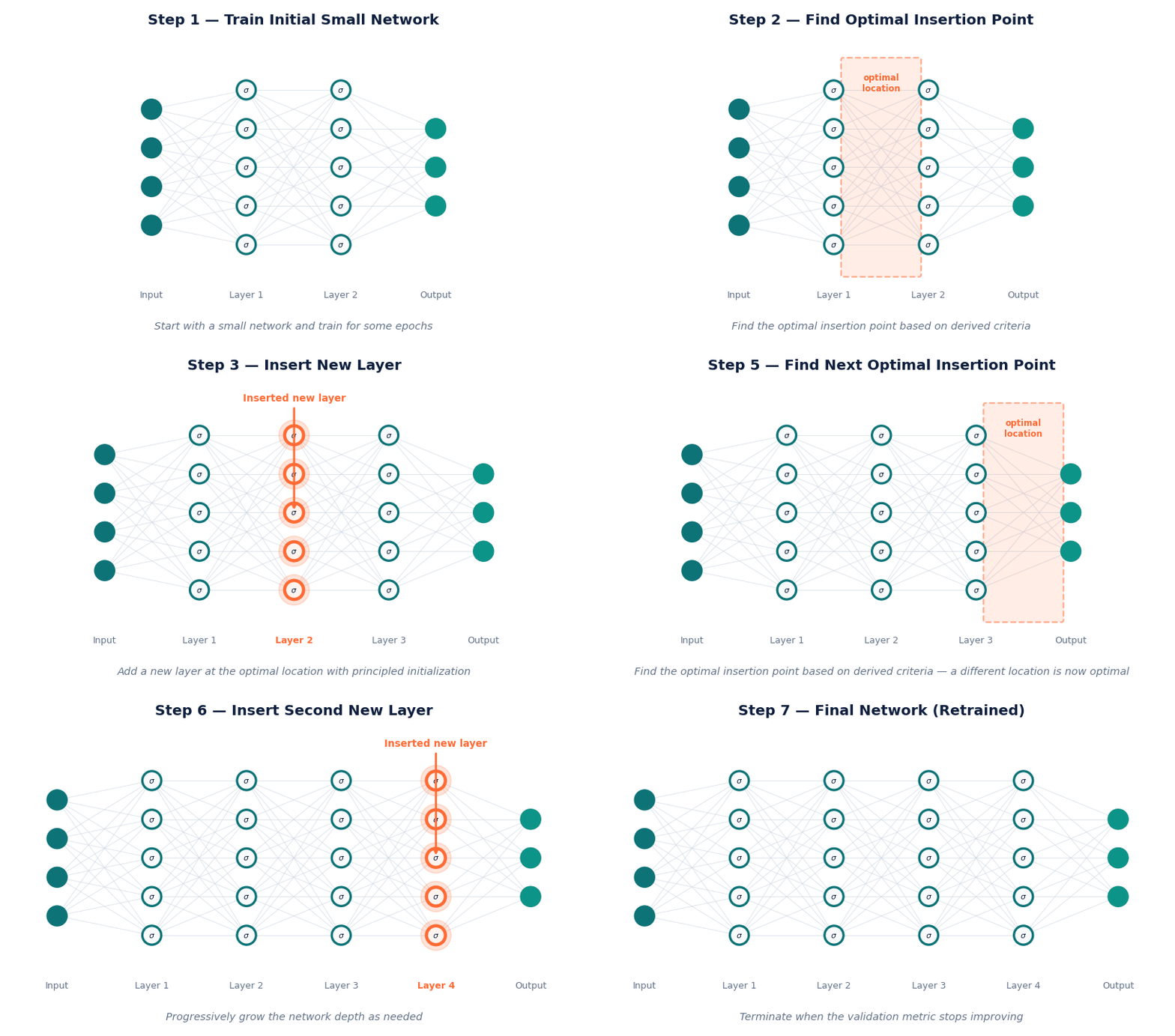
Topological derivative approach: starting from a small network, layers are inserted based on mathematically derived optimality conditions.
Current Research Focus
At Heidelberg, working with Prof. Jakob Zech, my focus is on the theoretical foundations of deep learning. I am currently working on expression rate analysis for Bayesian neural networks. Alongside this, I am interested in generative models for prior calibration in Bayesian inverse problems, and derivative-free methods for black-box optimization.
news
| Oct 14, 2026 | Upcoming talk: “On the Approximation Power of LiLaN for Simulating Stiff Nonlinear ODEs” at AstroAI-Lab, Heidelberg University, November 4, 2026. |
|---|---|
| Sep 15, 2026 | Invited talk on LiLaN: A linear latent network approach for fast simulation of stiff ODEs at Pasteur Labs , September 15, 2026. |
| Sep 1, 2026 | Our repository, ADABO: A Machine Learning-Assisted Approach for Black-Box Optimization, is now publicly available. |
| Jul 15, 2026 | Our new paper “Topological derivative approach for deep neural network architecture adaptation” has been accepted for publication in SIAM Journal on Scientific Computing. |
| Apr 25, 2026 | Our new work titled “From an Elementary Proof of Error Representation for Hermite Quadrature to a Rediscovery of Legendre Polynomials and Rodrigues Formula” is available in arXiv. |